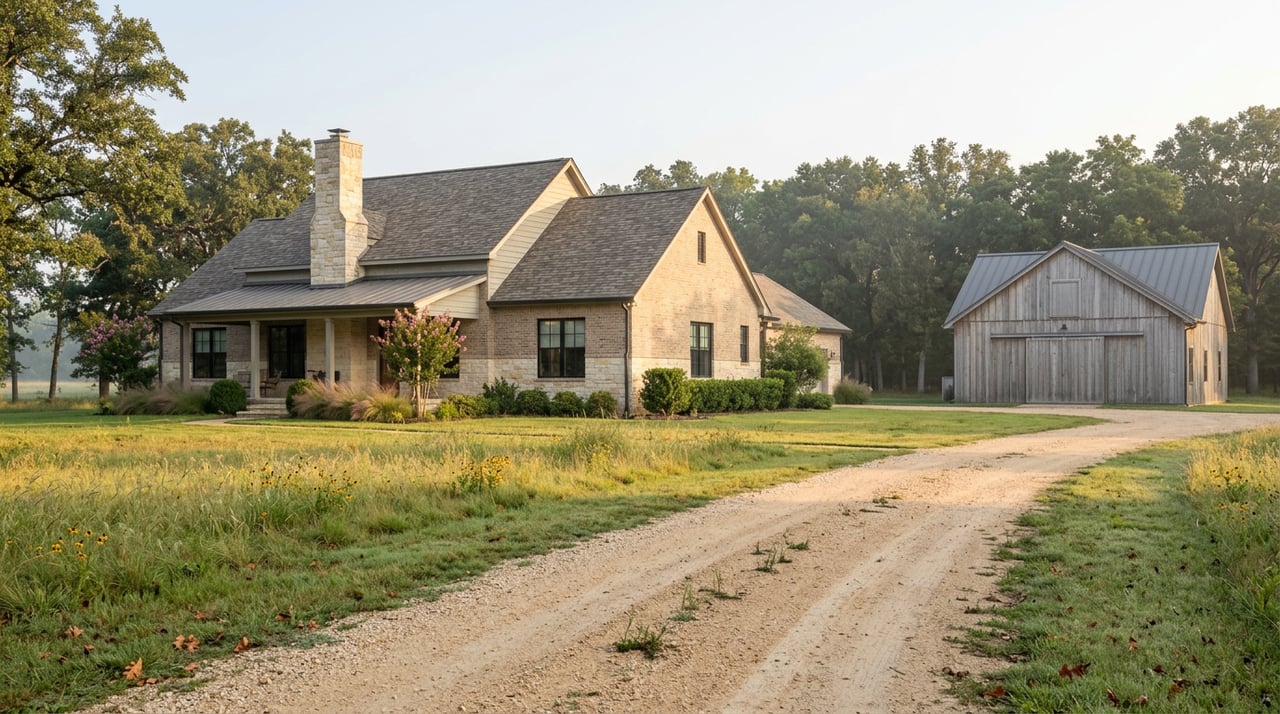
The Hidden Tax Bill Behind Bluebonnet Ridge's Horse Property Listings
August 20, 2026
August 20, 2026
Would you assume a listing's low property tax bill comes with the land, or with the person who currently owns it?
On Bluebonnet Drive, the gated country-estate street known locally as Bluebonnet Ridge, that question matters more than almost anywhere else in Rockwall County. These are not typical suburban lots. Parcels here run from roughly 6 acres up to 19.5 acres, with private-road access, well or co-op water, and septic systems doing the work city sewer does everywhere else in Rockwall. Several recent listings on the street have marketed barns, arenas, and horse-friendly pasture as part of the appeal. An important consideration is that the tax bill attached to that acreage is not a fixed feature of the property. It is a snapshot of how the current owner has been using the land, and it can change the moment a new owner does something different with it, sometimes without ever meaning to.
Texas does not technically offer an agricultural tax exemption. What it offers is a special valuation: land that qualifies gets appraised based on what it can produce, not what it would sell for on the open market, according to the Texas Comptroller. That difference can turn a five-figure tax bill into a four-figure one. It is also why low current taxes should be understood as conditional rather than permanent.
According to Simply Texan, Rockwall County's appraisal district generally sets the qualifying minimum at 10 acres for most agricultural uses, with a narrower carve-out for beekeeping operations that can qualify with as little as 5 acres. Bluebonnet Ridge's typical 6-to-19.5-acre range sits directly across that line. A parcel at 8 acres, which is roughly the size of one lot previously sold on the street, falls short of the standard 10-acre threshold on its own. A parcel at 12 acres, close to the size of a nearby English Road listing Sarah Naylor's team priced at $1.2 million earlier this year, clears it. Two homes on the same street, both marketed with the same country-estate language, can land on opposite sides of whether the county's productivity valuation even applies.
A key distinction for buyers is this: Owning horses on acreage does not automatically qualify land for agricultural valuation in Texas. Appraisal districts across the state, following the Comptroller's manual for agricultural land, draw a hard line between horses kept for recreation, showing, or riding and horses kept as part of an actual breeding operation. Recreational and stabled horses generally do not qualify. A pastured herd that meets minimum size and stocking-rate requirements can. The difference is not the animal. It is whether the operation looks and functions like agriculture rather than like a hobby with a nice view.
A barn and a cross-fenced pasture do not by themselves show whether the appraisal district currently classifies the land as agricultural, or whether the use qualifying it today is one you plan to continue. Rockwall Central Appraisal District publishes its own approved agricultural intensity standards, and any buyer weighing a Bluebonnet Ridge property with an existing ag valuation should request the current version and compare it with the land's current use and the use you plan to continue.
When land loses its qualifying agricultural use, whether from converting pasture to lawn, adding a pool where hay used to grow, or simply letting a herd sit below the required stocking rate, the county recalculates taxes as if the land had been valued at market rate all along, as explained by the Texas Comptroller. This is the rollback tax, and the terms differ depending on which valuation category applies.
Valuation type | Lookback period | Interest |
|---|---|---|
1-d | 3 years | 1% per month |
A potential rollback bill matters enormously on a street like this one. A buyer who closes on a Bluebonnet Ridge property with an existing ag valuation, then fences off pasture for a backyard or converts a hay field to turf, can trigger a bill covering years they did not even own the home.
A low tax line on an acreage listing describes last year's use. It does not promise anything about next year's.
Every home on Bluebonnet Drive that isn't tied to municipal utilities relies on a septic system, and one listing on the street specified an aerobic system paired with co-op water rather than a private well. According to Texas Septic Guide, sellers are still required to disclose known defects and complete a dedicated on-site sewer facility form detailing the system's type, age, and maintenance history. That paperwork exists whether or not anyone inspects the tank, and buyers can request it to review documented system details.
Financing adds another layer that acreage buyers on this street should not assume works the same way it does on a standard suburban lot. On a 6-to-8-acre parcel with a house, a barn, an arena, and a pasture already competing for space, well and septic system placement is worth reviewing early.
None of this makes Bluebonnet Ridge a harder place to buy or sell than it should be. It makes it a place where the paperwork carries more weight than the photos, which is exactly the kind of detail worth knowing before you are three weeks into a contract.
No. Texas appraisal districts generally require a genuine breeding operation with adequate herd size and stocking rates. Horses kept for recreation or riding typically do not qualify on their own.
A physical change in use, such as converting qualifying pasture or crop land to a homesite, lawn, or recreational feature. Letting a herd fall below the required stocking rate or stopping the qualifying activity can also trigger it.
Review the seller's septic disclosure form for the system's type, age, and maintenance history.
Often, yes.
If you are weighing acreage on Bluebonnet Drive, whether you are buying into it or preparing to sell, the tax and utility paperwork deserves the same scrutiny as the square footage. Sarah Naylor and her team work through these specifics on gated and acreage properties across Rockwall County every day. Get Your Instant Home Valuation or reach out directly to talk through what a specific Bluebonnet Ridge parcel's paperwork actually says before you write an offer.
This article is general information, not legal, tax or financial advice. Consult a qualified professional about your situation.
Stay up to date on the latest real estate trends.

Lifestyle

Sarah has strong negotiation skills, professional expertise, work ethic, and intimate knowledge of the Rockwall County area, and her reputation is backed by multiple “Best Real Estate Agent” awards.
Get in Touch With Our Team to Learn More

3125 RIDGE RD ROCKWALL TX 75032